
A personality test and a personal brand assessment may sound alike at first glance, and indeed, they are two powerful—but distinctly different—tools for professional and personal growth. But they serve different purposes and operate on different principles. When you want to understand yourself deeply and present your best self for career advancement, it’s essential to know how these methods differ, how they complement each other, and why ACIOTA™’s PersonalBrandIQ™ offers a unique approach.
The Stable Nature of Personality
A personality test or psychological test is designed to uncover the relatively stable aspects of who you are—your inherent preferences, natural tendencies, and behavioral patterns.
These traits, such as openness, extraversion, or emotional stability, form your psychological profile.
While your personality can slightly shift over time with experience and maturity, it remains largely consistent throughout your life.
A well-developed personality test helps you understand how you react, think, and interact based on your wiring.
Personality tests such as the popular 16Personalities (based on the Myers-Briggs framework) and CliftonStrengths (formerly StrengthsFinder) are designed to reveal your natural tendencies and strengths. 16Personalities categorizes you into one of 16 detailed types through questions on introversion vs. extroversion, how you process information, make decisions, and organize your life. For example, it asks if you feel energized by large groups (extrovert) or by one-on-one conversations (introvert), or if you make decisions based on logic (thinking) versus emotions (feeling). CliftonStrengths (StrengthsFinder) helps pinpoint your natural talents, such as strategic thinking or relationship-building, by presenting statements like “I enjoy taking charge of group projects” or “Building strong relationships is important to my professional success.” You rate how strongly each statement applies to you, producing a personal talents map.
Again, these tests provide a psychological profile: relatively stable characteristics that seldom change dramatically throughout life. Their main value lies in helping you understand your baseline—your strengths, preferences, and patterns. This self-knowledge serves as a foundation, and these traits, although not actively managed, become evident through your interactions with others. When you want to take control of how others see you, you must dig deeper into the current state of your Personal Brand – the way others see you or how you present yourself for new opportunities.
The Dynamic Nature of Personal Branding
Your personal brand isn’t static. It shifts throughout your career, reflecting your changing goals, roles, and even the audiences you want to reach. A personal branding assessment captures who you choose to be seen as – how much control you have over your Personal Brand – and how you express your unique value to the world.
Unlike personality, your personal brand evolves continually with your life stages, goals, and experiences.
As you take on different roles—student, professional, leader, mentor—you emphasize various parts of your identity to align with your ambitions.
Your PersonalBrandIQ™ reflects how intentionally and effectively you present these evolving aspects.
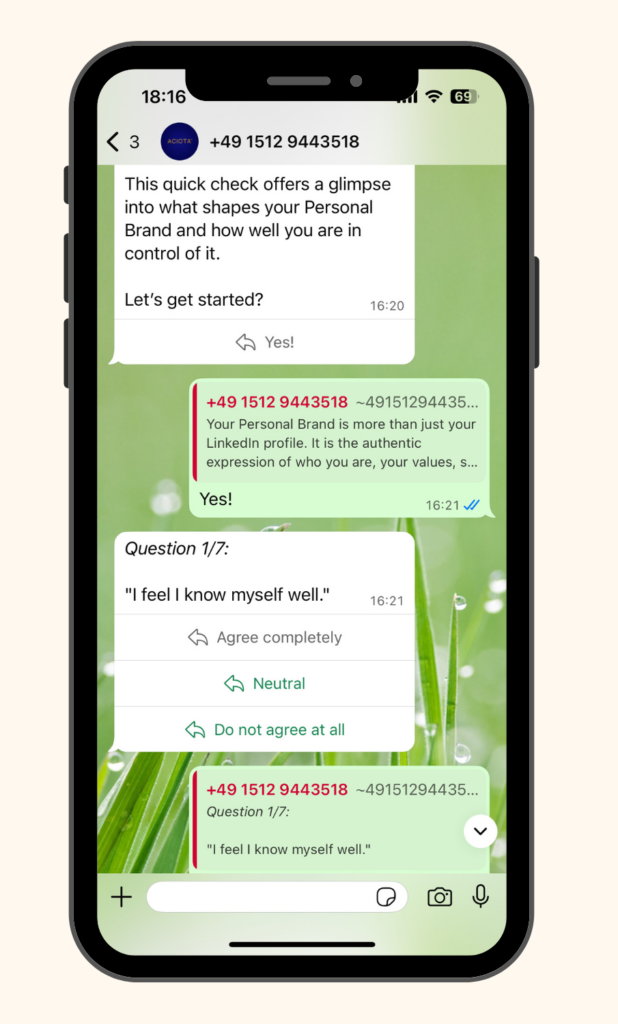
ACIOTA™ self assessment measures the current strength of your personal brand—the way your unique mix of skills, values, and personality is perceived in the marketplace. Our science-backed approach goes beyond self-discovery by evaluating how your brand aligns with your ambitions and how effectively you craft and communicate your reputation.
Within PersonalBrandIQ™ methodology, you gain a practical, actionable score based on four pillars:
- Human Capital: How your skills, achievements, and knowledge position you for professional success.
- Authenticity: The degree to which your outward brand reflects your true core, building trust and credibility.
- Self-Presentation: How confidently and clearly you present yourself both online and offline, from resumes to interviews to LinkedIn profiles.
- Adaptability: Your ability to adjust your narrative and emphasis as your career and goals evolve.
Instead of simply describing your traits, PersonalBrandIQ™ measures the strength and recognizability of your personal brand today—spotlighting both your assets and opportunities for growth. When you complete your ACIOTA Personal Brand assessment, you will be provided with a report that explains where you stand and what needs to be done to enhance your control over your Personal Brand. Moreover, you receive a workbook where you can capture those actionable steps and maintain accountability.
A strong personal brand doesn’t mean changing who you are; it means strategically highlighting the facets of yourself that best support your current goals. The more self-aware and skilled you are in doing this, the more control you have over your professional positioning.
Why Personal Brand Assessment Complements Personality Testing
Personality tests work from the inside out, clarifying your underlying makeup. A personal branding assessment begins at the interface between the self and the audience—how you translate that makeup into influence, trust, and opportunity.
While a personality test helps you understand your inner traits, a personal brand assessment helps you apply that understanding externally.
The personality test gives you a foundation: your values, motivations, and preferences.
The personal branding assessment builds on that foundation—helping you translate self-awareness into visibility, credibility, and professional impact.
Put simply, one measures who you are, while the other shapes how you are perceived.
A strong personal brand lets you intentionally highlight the aspects of your personality and skills that matter most for where you want to go next. The higher your PersonalBrandIQ™, the more in control you are of your reputation—making your career trajectory less about chance, and more about intention.
Your personality might be consistent, but your personal brand should be adaptive. Personality tests help you understand yourself; personal brand assessments help you strategically express that understanding. Developing your PersonalBrandIQ™ means learning to align perception with intention—so that the story others see is the one you mean to tell.
Hence, both are valuable tools. Personality insights support authenticity and emotional intelligence, while tools learnt through personal branding assessment help you communicate that authenticity in the right way for your goals. Combining both leads to clarity, confidence, and a more coherent career narrative.