

Feeling undervalued at work hits mid-career professionals hardest, often stalling the very growth they’re chasing after 5–15 years of experience. You’re leading projects, mentoring juniors, and quietly fixing what breaks—yet your title, scope, and pay don’t reflect the weight you’re actually carrying. You’re no longer junior, but you’re not quite “executive” either—and that in‑between zone is where careers silently stall.
This article introduces the “Value Exchange” framework to help you audit what you give versus what you get, so you can stop guessing, see the gap clearly, and take strategic action. By the end, you’ll know whether you’re in a fair exchange—and what to do if you’re not.
Why Mid-Career Value Gaps Hurt Most
Mid-career pros often quit due to limited advancement—a top reason cited by 41% in Mercer surveys—even when they deliver outsized results. At this stage, you’re not just executing; you’re expected to lead. But the systems around you don’t always update with your growth. Common traps include:
- Being the “reliable fixer” without sponsorship. Day-to-day, this looks like being pulled into every crisis, cleaning up messy launches, or rescuing failing projects—yet when strategic planning meetings happen, you’re not in the room. In reviews, you’re praised for being dependable, but no one is talking about your potential for the next level.
- Getting stuck in a “safe” box. You’ve proven you can deliver, so you’re constantly assigned what you’ve already done before. It’s flattering at first, then suffocating when you realize you’re not building anything new for your career story.
Over time, this shows up as:
- Stagnant pay despite clear impact
- Feedback fixated on tasks, not strategy
- Burnout from a loyalty that doesn’t feel reciprocated
This value gap erodes confidence, makes you question your worth, and quietly opens the door to better opportunities elsewhere—often for people who are no more capable than you, just better positioned.
7 Red Flags You’re Undervalued Mid-Career
If you’re unsure whether this is you, scan these red flags and see what resonates.
- Pay freezes while responsibilities balloon. Your scope has doubled, but your compensation looks like a cost-of-living adjustment, not a reflection of impact.
- No stretch projects or visible sponsorship. You’re left out of high-visibility initiatives and don’t have leaders actively advocating for you in promotion or succession conversations.
- You’re the go-to for crises but sidelined in planning. You’re trusted to clean up messes, not shape direction—pulled in when things break, left out when strategy is set.
- Juniors get celebrated; your wins go unmentioned. Promotions, shout-outs, and awards skew toward newer hires, while your contributions are treated as “expected.”
- Feedback ignores your expertise. Conversations stay focused on tasks, deadlines, and small improvements—not your strategic thinking, cross-functional influence, or leadership potential.
- Loyalty feels unreciprocated amid burnout. You stay late, cover gaps, and say yes to “one more thing,” but when you need support—budget, headcount, time—it’s a hard no.
- External LinkedIn traction outpaces internal growth. Your posts, case studies, and network are gaining momentum; recruiters are reaching out—but your title, pay, and scope inside the company haven’t moved in years.
Spot 4+? It’s time for an honest audit of your value exchange.
Your Value Exchange Canvas
Feeling valued is not vague or purely emotional—it’s a measurable exchange: what you contribute versus what you tangibly receive in return. Use this simple 2×2 canvas to map it.
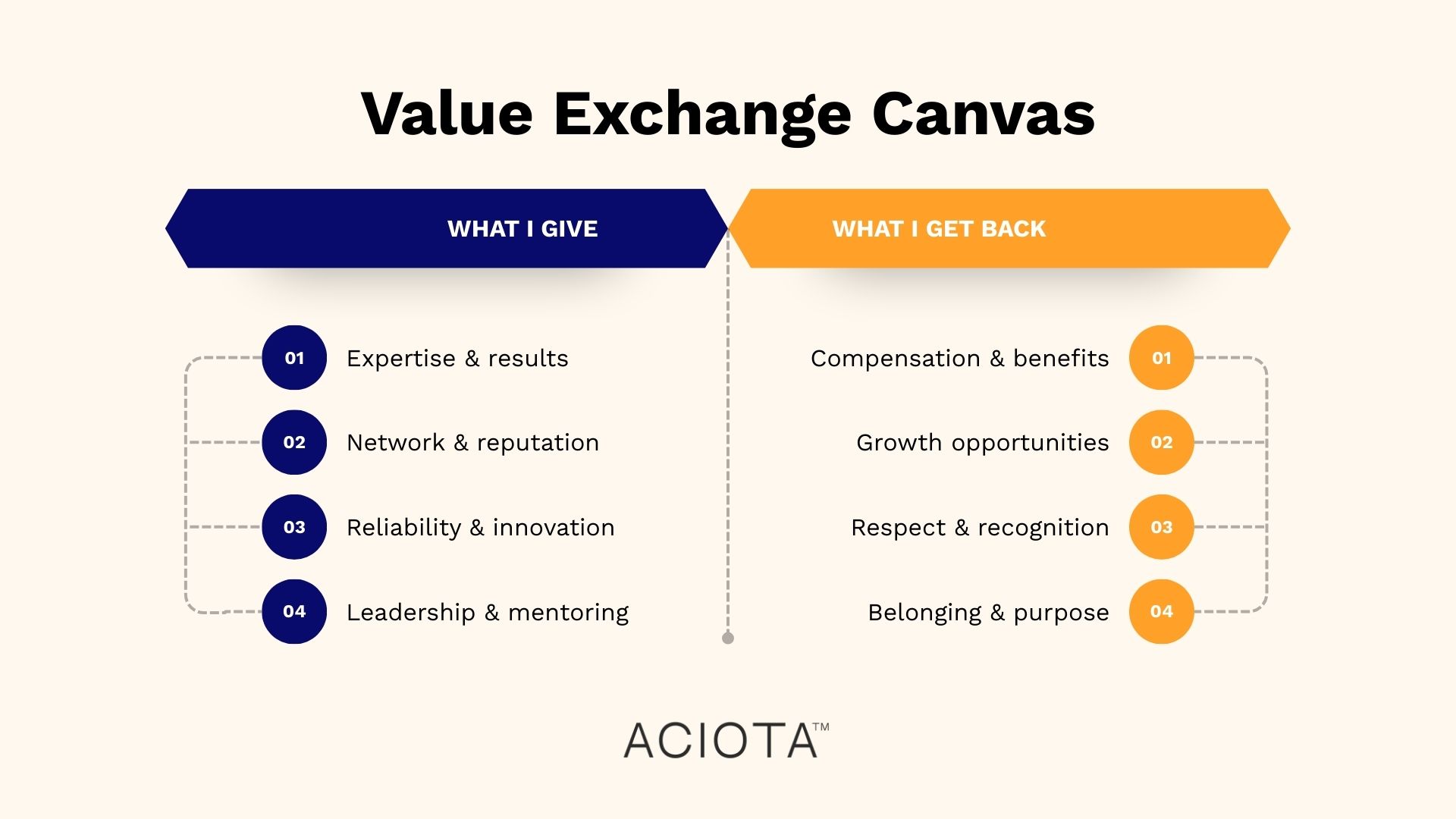
Score each cell from 1–10 weekly. “Give” scores reflect how much you’re investing; “Get” scores reflect how much value you receive back. Averages below 7 on the “get” side—especially when “give” is high—signal it’s time for action.
- Expertise & results (Give): 9 – You consistently ship complex work, fix problems, and hit ambitious targets.
- Compensation & benefits (Get): 5 – Your salary has barely moved, bonuses are inconsistent, and benefits lag the market.
Or:
- Leadership & mentoring (Give): 8 – You unofficially lead a team, coach juniors, and are the “glue” in your group.
- Belonging & purpose (Get): 4 – You don’t feel included in key decisions, and the work no longer aligns with what energizes you.
If your “give” scores are consistently 8–10 and your “get” scores sit at 4–6, you’re in a chronic value deficit. Reviewing this over 3–6 months shows whether things are improving, plateauing, or getting worse—so you can respond with data, not just frustration.
This canvas aligns directly with personal branding: strong, balanced exchanges build the reputation that powers your PersonalBrandIQ™ score. When your contributions are visible and fairly rewarded, your brand becomes “high impact, high trust”—exactly what PersonalBrandIQ™ is designed to quantify for visibility, credibility, and consistency.
Start your assessment today, and use it as a living dashboard for your career.
5 Strategic Moves to Rebalance Your Exchange
Don’t wait passively for recognition. Mid-career builders act strategically to fix imbalances and accelerate their careers. Use these five moves to turn “undervalued” into leverage.
- Build Your Brag File
Keep a running, private document that captures your concrete wins: what you did, how you did it, and the measurable outcome.
Include items like:
- “Reduced onboarding time by 30% by redesigning our training flow and documentation.”
- “Led a cross-functional launch that increased signups by 18% in Q2.”
- “Implemented a new reporting process that cut leadership prep time by 10 hours per month.”
Use this in performance reviews, promotion cases, and compensation conversations. It shifts the dialogue from “I feel undervalued” to “Here is the value I’ve created.”
- Seek Sponsors Over Mentors
Mentors advise you. Sponsors advocate for you when you’re not in the room.
Identify leaders who:
- Have influence in promotion or staffing decisions
- Have seen you deliver or benefited from your work
- Are aligned with the type of roles you want next
Approach them after visible wins—for example, right after a successful launch or project. Try language like: “I’d love to contribute more visibly to our company goals. Based on what you’ve seen from me, where do you think I could have the most impact at the next level?”
Meet periodically to share updates, ask for feedback, and explicitly invite their advocacy: “If you see opportunities where I can lead X-type work, I’d be excited to step in.” Sponsors don’t just encourage you—they create opportunities.
- Job Craft Proactively
Don’t wait for the perfect role to be posted. Shape your current job to better match your strengths and the organization’s priorities. A great LinkedIn article on how to gain momentum with new projects even in imperfect conditions.
Propose projects that:
- Solve real business problems, and
- Showcase the value you want to be known for
Example ideas:
- “Leading our Q3 innovation sprint to test three new product ideas with customers.”
- “Owning customer insights for our next product launch, consolidating feedback across teams.”
- “Standing up a cross-functional task force to reduce churn by improving onboarding and support.”
Frame these proposals as experiments or pilots with clear outcomes and timelines. This creates proof points that support promotions, title changes, and expanded scope.
- Amplify Externally
If your internal visibility is capped, build external visibility that reflects your true value. Share anonymized case studies of your work on LinkedIn, focusing on:
- Problem: What challenge were you facing?
- Your role: What did you own or drive?
- Result: What changed? (Numbers help.)
- Takeaway: What others can learn or apply.
This builds your market value, attracts recruiters, and sometimes nudges your current company to recognize what others clearly see.
- Benchmark and Exit Smart
If your compensation, scope, or recognition gaps persist for 12+ months despite clear effort and evidence, it’s time to get objective.
Benchmark using:
- Market data (salary surveys, compensation websites such as Glassdoor, or Levels.fyi for tech roles)
- Conversations with trusted peers in similar roles
- Recruiter outreach to understand current ranges and expectations
Come back with a grounded ask: “Here’s what I’m seeing in the market for similar roles with similar scope. Given the impact I’ve delivered, I’d like to discuss aligning my compensation and title accordingly.” If the answer is consistently “no,” or the timeline is vague and repeatedly pushed, use your brag file, sponsors, and external visibility to pivot. Exiting with clarity beats staying in a chronic value deficit. These moves transform being undervalued from a source of frustration into data-backed leverage—fuel for promotions, smarter negotiations, and long-term pride in your trajectory.
Turn Insights into Action with ACIOTA™ Personal Brand
A balanced value exchange isn’t just satisfying—it’s rocket fuel for mid-career momentum. When what you give and what you get are aligned, promotions feel earned instead of random, new roles come from pull (you’re sought out) instead of endless pushing, and your career story becomes coherent, not accidental. You stop relying on luck or “being noticed,” and start operating from clarity: you know your value, you can show it, and you can ask for what matches it.
If you want to see exactly where your professional brand stands today, the ACIOTA™ Personal Brand Assessment can help. Answer 75 targeted questions, and you’ll receive a custom report and workbook in minutes, mapping how you’re perceived across visibility, credibility, and consistency—and where your value exchange is out of balance.
Ready to benchmark your professional value and rebuild your momentum with intention? Take the ACIOTA™ Personal Brand Assessment and turn your mid-career into your strongest career chapter yet.